Description
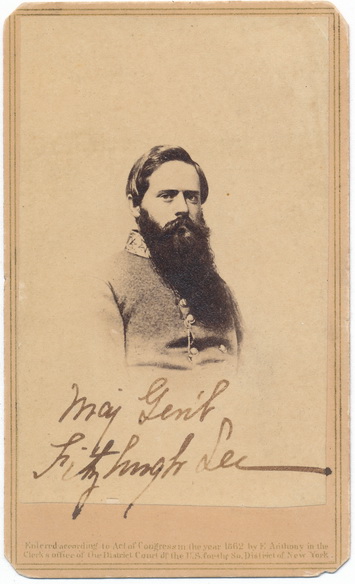
Very nice carte view of Confederate General Fitzhugh Lee. A skilled leader, Lee performed well in the Maryland Campaign of 1862, covering the Confederate infantry’s withdrawal from South Mountain, delaying the Union Army advance to Sharpsburg, Maryland, before the Battle of Antietam, and covering his army’s recrossing of the Potomac River into Virginia. He conducted the cavalry action of Kelly’s Ford with skill and success, where his 400 troopers captured 150 men and horses with a loss of only 14 men. In the Battle of Chancellorsville in May 1863, Lee’s reconnaissance found that the Union Army’s right flank was “in the air”, which allowed the successful flanking attack by Maj. Gen. Thomas J. “Stonewall” Jackson, a movement led by Lee’s cavalry. After Chancellorsville, Lee was incapacitated by inflammatory rheumatism, missing a month of action. He recovered in time to lead a brigade in Jeb Stuart’s ride around the Union Army in the early days of the Gettysburg Campaign, with his most significant contribution being at the Battle of Carlisle. During the Battle of Gettysburg, his brigade fought unsuccessfully in the action at East Cavalry Field. Stuart’s report singled out no officer in his command for praise except Fitz Lee, who he said was “one of the finest cavalry leaders on the continent, and richly [entitled] to promotion.” Lee was promoted to major general on August 3, 1863. In the Overland and Petersburg campaigns of 1864, he was constantly employed as a divisional commander under Stuart, and, after Stuart’s death, under Maj. Gen. Wade Hampton. Hampton, who had been Lee’s peer for much of the war, was promoted to replace Stuart. Despite Lee’s abilities, in 1864 he was unable to break through United States Colored Troops defense of Fort Pocahontas in Charles City County. Lee took part in Lt. Gen. Jubal A. Early’s campaign against Maj. Gen. Philip Sheridan in the Shenandoah Valley, and at Third Winchester, three horses were shot under him and he was severely wounded. When General Hampton was sent to assist General Joseph E. Johnston in North Carolina, the command of the whole of Robert E. Lee’s cavalry devolved upon Fitzhugh Lee on March 29, 1865, but the surrender at Appomattox followed quickly upon the opening of the campaign. Fitzhugh Lee himself led the last charge of the Confederates on April 9 that year at Farmville, Virginia. This one is signed on the front in period ink reading, “Maj Genl Fitzhugh Lee”, and it does appear to be his signature, although I would suspect it was done post war. Back marked by Anthony.